

Introduction
Auto Pools, a feature of SaucerSwap V2 leveraging ICHI’s ‘Yield IQ’ for Active Liquidity Management (ALM), are launching in March 2024. This feature simplifies concentrated liquidity provision by allowing users to deposit a single token into an automated vault. These vaults allocate funds across specific price ranges in the underlying liquidity pool to optimize fee earnings and mitigate impermanent loss risk, making the process efficient and user-friendly.
The term ‘ichi,’ meaning ‘one’ in Japanese, aptly reflects their defining single-asset deposit mechanism, requiring users to provide just one token for liquidity, from which the protocol takes over the management process to keep liquidity concentrated around the active tick.
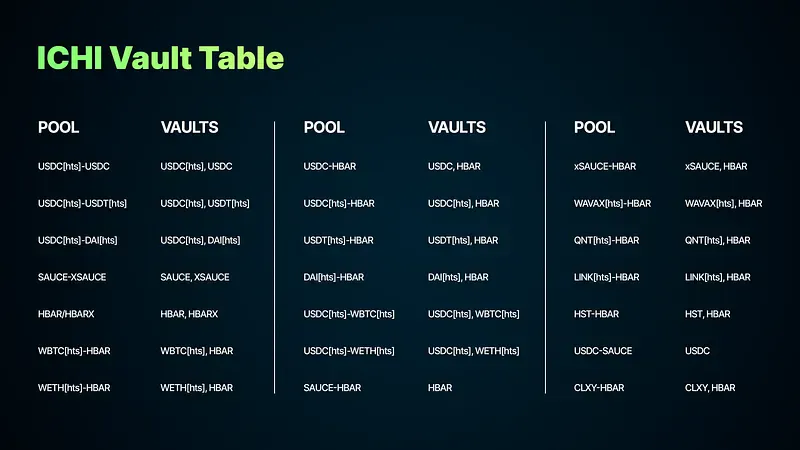
Auto Pools are set to integrate with all SaucerSwap V2 pools, with most pools offering two vaults (one for each token in the pool). Despite Auto Pools supporting all V2 pools, users will always have the flexibility to create a manual position in any SaucerSwap V2 pool if they prefer. For instance, the WBTC[hts]/HBAR pool has vaults for both WBTC[hts] and HBAR. The SAUCE/HBAR and SAUCE/USDC pools are exceptions, offering vaults specifically for HBAR and USDC, respectively.
Key Features of Auto Pools
Single-Token Deposit: Users can contribute to liquidity pools using just one asset, receiving ERC-20 LP tokens in return. This simplification enhances accessibility and convenience.
Dynamic Rebalancing: Auto Pools employ a rebalancing algorithm that adjusts to market conditions through five operational states — Healthy, Over-Inventory, Under-Inventory, High Volatility, and Extreme Volatility — maximizing efficiency and minimizing risk (details below).
Dual Vaults: Each V2 pool has two vaults, allowing for a more tailored approach to liquidity management, with a special exception made for SAUCE/HBAR and SAUCE/USDC pairs.
LARI: Participation in Auto Pools qualifies for LARI rewards, making liquidity providers (LPs) eligible for heightened rewards based on the vault’s liquidity management efficiency, the depositor’s share, deposit duration, and the LARI weight of the underlying pool.
Operation and Mechanism of Auto Pools
Auto Pools simplify the liquidity provision process in SaucerSwap V2 by allowing LPs to deposit a single asset into a vault. Upon deposit, LPs receive fungible ERC-20 LP tokens, representing their share of the vault. These assets are strategically deployed into SaucerSwap V2 concentrated liquidity pools, with Auto Pools adjusting positions based on market conditions to optimize fee earnings and reduce the risk of impermanent loss.
LPs earn trading fees from the pools’ activities and can experience potential appreciation of their assets. The protocol ensures flexibility, allowing for the withdrawal of the initial deposit and any accrued earnings at any time.
Auto Pools apply a 14% management fee on earned fees, distributed to ICHI Protocol and related entities.
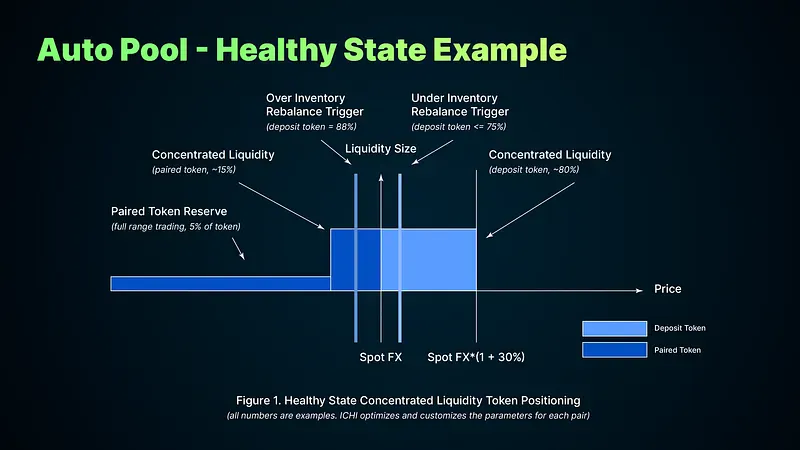
The heart of Auto Pools lies in its dynamic rebalancing strategy, crafted to navigate market movements effectively. The vaults adapt through five operational states — Healthy, Over-Inventory, Under-Inventory, High Volatility, and Extreme Volatility — each tailored to optimize performance and mitigate risk.
- Healthy: Aimed at maintaining an optimal balance between the deposit and paired tokens to ensure stable returns. Example composition: 20% paired token / 80% deposit token.
- Over-Inventory: Triggers when excess deposit tokens accumulate, prompting a strategy to sell the deposit token and return to a healthy state. Example composition: 12% paired token / 88% deposit token.
- Under-Inventory: Triggers when excess paired tokens accumulate, prompting a strategy to sell the paired token and return to a healthy state. Example composition: 25% paired token / 75% deposit token.
- High Volatility: Differences between fast 5-min and slow 60-min time-weighted average prices (TWAPs), as well as between current price and fast TWAP is used to detect such price movements. The liquidity will be spread out into full range for both tokens. Example composition: 50% paired token / 50% deposit token.
- Extreme Volatility: In cases of severe market fluctuations, the protocol halts further deposits, requiring manual intervention for rebalancing.
For a more in-depth explanation, see the ICHI docs.
Conclusion
Auto Pools in SaucerSwap V2, developed in collaboration with ICHI, streamline liquidity provision. These vaults utilize a rebalancing algorithm to optimize capital allocation, enabling users to deposit a single token for automated liquidity management. Auto Pools aim to make concentrated liquidity more efficient, user-friendly, and powerful.


