

The Hedera network is fast, fair, secure, and well governed, which provides the trust layer that our ever-growing community relies on.
- Dr. Leemon Baird, inventor of the hashgraph
The use case of DeFi is clear and simple to the vast majority of market participants in the crypto space; namely, on-chain access to services traditionally offered by banks via trustless smart contracts. The general ethos revolves around a sort of libertarian right to self-sovereignty with a focus on egalitarianism. In theory, every individual may access these money markets using the same technology with complete transparency and no special advantage over the protocol. For money markets to be capital-efficient and attractive, they need high liquidity. Go where the money is. For now, this happens to be Ethereum.
Ignoring the highly fragile systems we have seen collapse in 2022, such as Terra and any number of protocols rebranding perpetual motion machines to a new crop of speculators, DeFi is here to stay. However, does it need to stay on Ethereum? Though protocols such as Aave or MakerDAO are sustainable, fair systems which have proven resilient to market volatility, the platform upon which they are currently housed is not as fair as it may seem.
DeFi on Ethereum is plagued by three problems: prohibitive costs, low throughput, and a lack of fair ordering (MEV). Take Curve for example; as of writing this, the cost of a token swap is $4.66. While this seems rather high, one should remember that this is relatively low when compared to historical data.
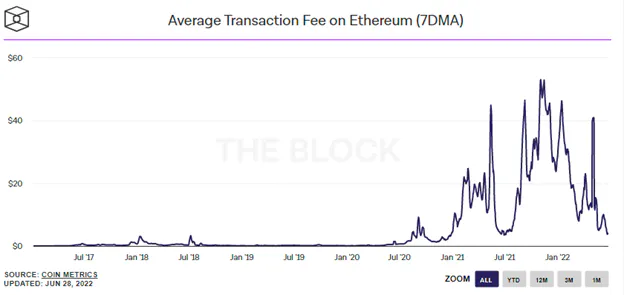
Fee data and charts referenced from: The Block, On-Chain Metrics, Ethereum, June 2022
Fees on Ethereum are priced in gwei. Gwei is to Ethereum what sats are to Bitcoin — a fractional representation*.* When the price of ETH rises, so too does the U.S. dollar cost of transacting on the network, as can be seen when comparing the above Figure with the ETH/USD chart.
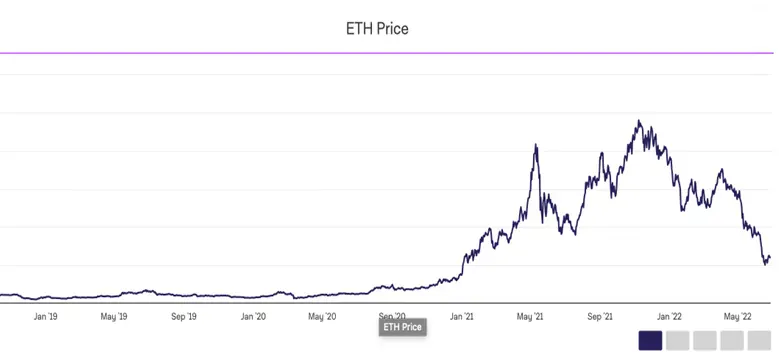
Fee data and charts referenced from: The Block, On-Chain Metrics, Ethereum, June 2022
Sharp rises in the price of ETH also correlate with demand for blockspace. This creates a negative feedback loop for users and protocols whereby demand effectively destroys itself by making the use of mainnet cost-prohibitive.
The variable nature of Ethereum’s transaction fees makes it difficult for developers to take costs into account when looking to build what is fundamentally a business on web3. No business owner wants unpredictable, wildly fluctuating expenses. There simply is not enough blockspace to run anything remotely similar to modern banking infrastructure. Ethereum runs at a maximum of 30 transactions per second. In comparison, Visa can run up to [65,000 transaction messages per second](https://www.visa.ca/en_CA/about-visa/visanet.html#:~:text=VisaNet%2520can%2520authorize%2520up%2520to,,%2520yen,%2520centavo%2520or%2520santang.).
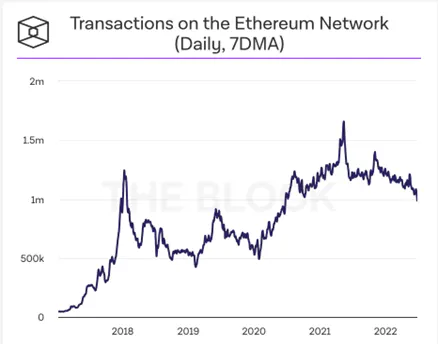
Fee data and charts referenced from: The Block, On-Chain Metrics, Ethereum, June 2022
The technical limitations of Ethereum, coupled with its high demand for blockspace, give rise to DeFi’s third problem: miner extractable value. Abbreviated to MEV, miner extractable value consists of a live auction by market participants, each using Gwei to bribe miners to include and validate their transaction before another. This creates an arbitrage opportunity, which, if transactions were ordered fairly, would not have been possible. MEV ‘searchers’ (as they are called) typically profit from this backdoor arbitrage by front running large market orders and pocketing the difference.
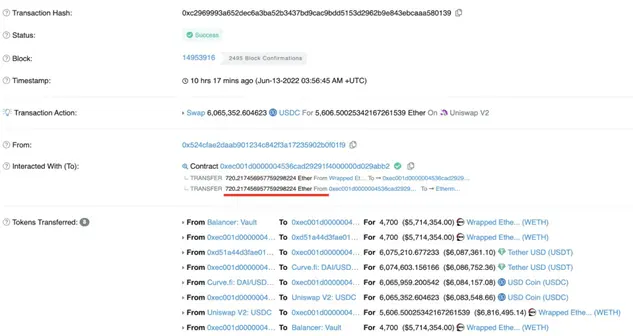
Twitter user @bertcmiller shares a post with his following on June 13th with screenshots detailing profits generated by MEV bots taking advantage of an ETH whale market selling into a small (relative to his market order) liquidity pool. @bertcmiller’s post: https://twitter.com/bertcmiller/status/1536353430717046786/photo/1
Arbitrage is a normal and healthy part of any market; however, this kind of arbitrage sacrifices the fair ordering of transactions.
When developing SaucerSwap, we knew it had to be future-proof. A protocol which stood up against the rest of the market’s DeFi offerings, while also addressing the core problems users are growing increasingly tired of on Ethereum. The Hedera Hashgraph offers us and our users up to 10,000 transactions per second (throttled), alleviating our throughput concerns. Predictable fees paid in HBAR but denominated in U.S. dollars give us the freedom to explore ideas that would be impossible on other DLTs. Lastly, the concept of MEV does not exists on Hedera, meaning the network is free of bribes and exploitative backdoor arbitrage. The hashgraph always guarantees fair ordering of transactions; giving rise to a secure and fair network upon which next-generation dApps and protocols can be built.


