

Introduction
V3 is the most ambitious product SaucerSwap Labs has built.
For three years, we've been a liquidity layer: infrastructure that enables trading. V3 makes us a trading platform. A full central limit order book on Hedera's L1, launching Q2 2026, with its own interface, fee structure, and economic model.
Hedera has always had more capacity than DeFi has demanded from it. 10,000+ TPS, deterministic ordering, finality in seconds. AMMs don't need that kind of throughput. Order books do.
AMMs and order books serve fundamentally different needs. AMMs are permissionless and well-suited for retail traders and liquidity providers. Order books are the instrument of choice for institutions, professional market makers, and anyone who needs precise price control and the ability to deploy serious capital without moving the market. Until now, DeFi on Hedera has only had the former. V3 adds the latter.
V3 introduces real utility for SAUCE at the protocol level. xSAUCE holders receive trading fee discounts on V3, linking governance participation directly to platform economics.
Hyperliquid and dYdX proved the institutional appetite for on-chain order books. V3 competes at that level on Hedera's L1 — no L2s, no custom chains.
The Trading Experience
The layout is instantly familiar to anyone who's traded on a centralized exchange.
TradingView Advanced Charts power the left panel: full OHLCV candles, multiple timeframes from 1-minute to weekly, volume bars, and real-time streaming updates. The order book ladder sits to the right with bids, asks, cumulative totals, spread, and depth updating via WebSocket. Below the chart is order management: open orders, order history, filled positions, and wallet balances.
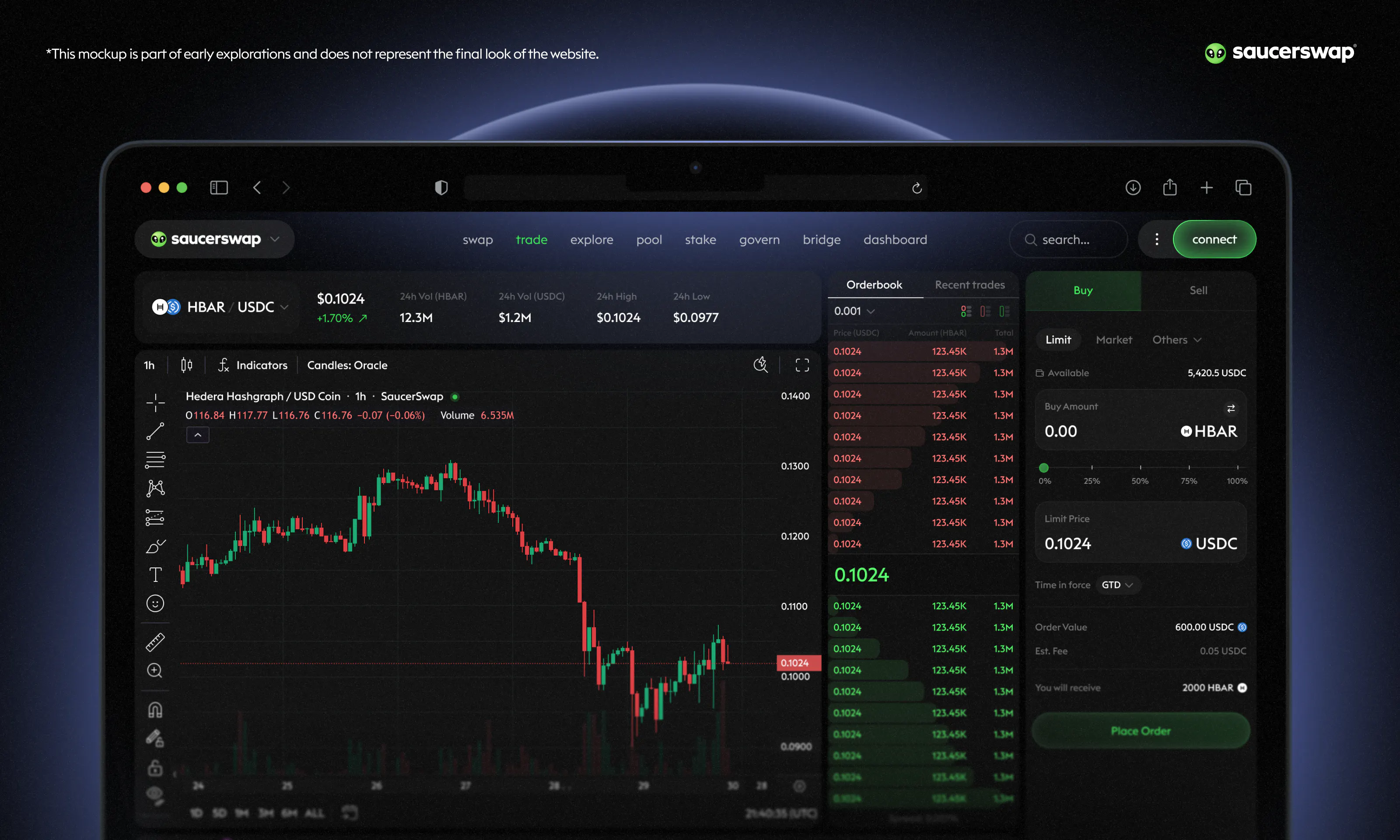
Launch order types: market and limit, with post-only for makers and configurable time-in-force. Iceberg, stop-loss, take-profit, DCA, and more are planned for subsequent releases.
Onboarding takes one minute: connect your wallet and approve the tokens you want to trade. Approvals are per-token (not per-market), so once you've approved a token, it works across every market that uses it. After that, placing an order is a single off-chain wallet signature. No fees, no waiting for a transaction. You're signing an intent. Your funds don't move unless your order actually executes. Cancellations are instant and free.
You get complete order history with filtering, sorting, and search. Click into any order and see individual fill breakdowns: exactly what price you got on each partial fill, slippage, everything. Every fill settles on-chain and is independently verifiable. We're building a signature verification page so anyone can confirm a specific order was signed by a given Hedera account. Order signatures can also be verified independently using the signer's public key. No trust in our systems required.
The interface is fully responsive and mobile-optimized, with dedicated Trade and Chart views on any screen size.
At launch, we're starting with curated markets. The highest-volume pairs on Hedera: HBAR-USDC, WETH-USDC, WBTC-USDC, SAUCE-USDC, plus select ecosystem tokens. Order books require continuously maintained depth near the current price. For long-tail tokens, V1/V2 remain the better fit.
Technical Architecture
Hybrid Matching and Settlement
Orders are matched off-chain through a purpose-built matching engine with millisecond execution. Settlement occurs directly on Hedera's L1 in a single atomic transaction. No intermediary steps, no bridges, no rollups. Price and quantity parameters execute exactly as specified or fail completely. No fee incurred.
Sub-second order placement, near-instant cancellations, real-time book updates via WebSockets. Most order book DEXs need L2s or appchains to hit acceptable performance. V3 runs on Hedera's L1 and achieves better results.
Intent-Based Settlement
V3 uses an intent-based order model. Users sign a structured order off-chain that specifies exact parameters: token pair, order type, execution price, and amount. This signed intent is the authorization. A settlement contract on Hedera's L1 executes matched orders atomically.
Users approve tokens once and sign orders as needed. No per-trade gas fees, no token wrapping, no repeated approvals.
Unified Liquidity
V3 doesn't replace V1 and V2. It uses them.
When the order book cannot fully fill a trade, V3 taps into V1 and V2 liquidity pools as a backstop, routing to the deepest available liquidity across all versions.
Backstop fills only trigger when they improve execution for the trader. Slippage checks, price divergence detection, and minimum pool liquidity requirements prevent bad fills. Launches with curated markets where backstop fills are most valuable, expanding over time.
Governance and Security
Markets are configurable through governance: maker/taker fees, tick sizes, minimum order sizes. At launch, market listings are curated and permissioned. Over time, the DAO takes over new market creation and parameter adjustment.
Security details, audit scope, and the settlement layer's trust model will be published ahead of launch.
Professional-Grade API
V3 ships with REST and WebSocket APIs for professional traders and market makers. Batch operations, tiered API access, and higher throughput for market makers with meaningful volume.
Tokenomics
Where SaucerSwap is Today
V3 changes how the protocol generates and distributes value. Here's the current baseline and what shifts.
- V1: ~$230M volume / $15M TVL over the last 12 months.
- V2: ~$3B volume / $26M TVL, representing ~93% of protocol volume.
- Total since August 2022: just over $6B.
The growth curve matters more than the total: $3B of that volume arrived in the last 12 months. Half of all lifetime activity in one year. That's consistent with what we've been optimizing on the incentives side, most recently in Proposal 5817, which shifted rewards toward a fee-primary, health-adjusted allocation framework with concentration controls.
V3 Changes the Economic Engine
Order books monetize differently than AMMs: instead of a single swap fee, fees are split between takers (who remove liquidity by crossing the spread) and makers (who provide liquidity by posting resting orders). The maker/taker schedule is configurable per market and is ultimately governed by the DAO. SaucerSwap Labs will publish an RFC ahead of launch with a recommended fee and incentive framework, followed by a feedback period before any proposal goes on-chain. The goal: improve execution quality, not subsidize wash volume.
Maker/Taker Fees and Rebates
At launch, the fee posture we’re working toward is a taker fee in the 5–15 bps range (with a proposed default near 8 bps) and 0 bps maker. That alone is often sufficient in mature markets, but V3 also introduces a controlled lever AMMs don’t have: negative maker fees (maker rebates) on select markets where depth is thin and spreads need tightening. A maker rebate means LPs are paid when their resting orders are filled. These rebates are funded directly from taker fees, not token emissions. The remainder accrues to the protocol as net fees. Incentives are tied to real trading activity and measurable quoting quality, taperable by governance as markets stabilize.
xSAUCE as Protocol-Level Utility
This is where SAUCE becomes protocol-level utility, not just governance and fee capture.
On V3, xSAUCE acts as a fee modifier. Stake SAUCE into xSAUCE and receive tiered multipliers on the market's baseline fee schedule.
Positive taker fee → staking reduces it.
Positive maker fee → staking reduces it.
Negative maker fee → staking increases the rebate.
This reduces effective trading costs without rewriting headline fees, and it encourages sticky behavior. Serious traders commit capital to SAUCE because it directly improves their unit economics.
Buybacks and Fee Routing
V3 plugs into the existing fee-to-buyback loop already live on V1 and V2, but with a more fee-productive venue and a clearer set of governance levers. The core accounting is simple: net protocol fees = taker fees collected − maker rebates paid (maker fees add to net; maker rebates reduce it). Net fees route into the BrewSaucer contract and convert to SAUCE through buybacks. Bought-back SAUCE is distributed across configurable buckets: staking rewards, the POL + Incentive Reserve, development funding, and a burn allocation. The burn will be included in the upcoming RFC as part of the initial governance package. The Reserve funds LP incentives today and can extend to V3 incentives over time.
The burn is a long-term supply-discipline signal: funded from a defined share of retained reserves, trading reserve optionality for permanent supply reduction while keeping core incentive pathways intact. Trading activity generates fees, fees drive buybacks, SAUCE flows back into the ecosystem. No reliance on one-way emissions.
Emissions Replacement and the Path to Fee-Driven Sustainment
The longer-run trajectory: a gradual shift from emissions dependency to fee-driven sustainment. We modeled this conservatively — V1/V2 volumes grown at 42% YoY from a 2025 baseline, V3 launching May 2026, V3 adoption modeled as a ramp in share of total protocol volume — to estimate how much MasterChef emissions can be offset by recycled fees.
In the baseline case, V3 reaches roughly 50% of period volume by H2 2027 (about $2.24B of $4.48B), which corresponds to roughly $3.74B of V3 volume in calendar 2027 (about 45.5% of ~$8.22B total protocol volume).
Under default assumptions (representative fee discount for staked SAUCE, safety-capped rebate program), the model estimates buybacks cover ~31.7% of MasterChef emissions in 2026 (partial-year V3) and ~94.7% in 2027 (full-year V3 plus higher volumes). These are model outputs, not guarantees. Realized replacement depends on sustained volume, market mix, and governance-selected fee parameters. But the direction is clear: by 2027, the system is modeled to be near emissions-neutral. Usage becomes the base layer.
Phase 2: Competitive Maker Incentives
Phase 1 introduces the core levers: market-level maker/taker pricing, optional maker rebates, xSAUCE fee modifiers. Phase 2 adds volume-weighted maker rebate tiers, keyed to a maker's sustained share of volume within a given market over a rolling 14-day window.
The goal: reward continuous contribution to depth and spread quality, concentrate incentives on priority markets, create competitive pressure among professional makers. Without permanently raising taker fees.
The Institutional Case
Institutional capital has never found a natural home in AMM-based DeFi. Institutions have spent decades in order book environments. They understand the execution models, risk management frameworks, and compliance interfaces. AMMs require a fundamentally different paradigm, and their structural limitations (impermanent loss, slippage on size, fragmented liquidity) don't clear institutional risk committees.
Order books are the native interface for institutional trading. V3 gives Hedera one. With compliance integrations and custody partnerships, that's a real path to institutional volume on-chain.
Perpetuals
V3's matching engine, order management infrastructure, APIs, and market maker relationships are the direct foundation for perpetuals. We're not building perps as a separate product. They're the next phase of the same system. More on this soon.
What's Next
V3 launches Q2 2026.
Fee and tokenomics RFC, market listings, and integration details to follow.


